On January 23rd 2011, I uploaded my first photograph onto my Instagram account. I was excited to start a new form of social media and keep up with everything. I have always loved photography, art and being creative, so I thought Instagram would be a perfect opportunity to show my friends, family and followers all about myself and what my interests are. As Instagram became more popular, I quickly started to notice my screen time increasing. My mental state started to plummet and I began to feel as if my life wasn’t enough. I would compare myself to others and had an unrealistic view of reality.
When the social media influencer title was invented, I quickly watched as the online world completely changed.
Instagram was developed by Kevin Systrom and Mike Krieger in San Francisco in 2010. As there were many other platforms already similar at the time, the app was designed to capture images and tell stories through captions. The name Instagram was derived from the word telegram – which generates quick messages to the users. By the first year, there were 10 million users on the app. Now there are over 1 billion users uploading worldwide.
Every single morning I would open the app as soon as I woke and began my day. I became obsessed at scrolling and checking posts every few hours. It wasn’t healthy in any sense and I forgot how beautiful real life actually was. Eventually I saw what it was really doing to people and I watched them change.
It ended up being about how many likes and followers a person had, finding the best hash tag, using the perfect filter and how aesthetic a photograph was. I just couldn’t see the point anymore. Everyone was competing for the best photograph and comments were becoming nasty for no reason at all.
Instagram results in passive use and social comparison. Passive use is when users monitor known or unknown accounts without engagement. This isn’t beneficial to their health, as envy and jealousy can occur (Verduyn et al., 2017, p. 281). Social comparison is an outcome of envy and consequently alters a person’s state of mind (Festinger, 1954). Social media users are more likely to experience feelings of inferiority, hostility and resentment according to Smith and Kim (2007, p. 49).
A few articles posted below on my TWITTER account explain the pros and cons of Instagram and discuss the general mental health issues within the app:
Social media use, especially Instagram has exploded over the last few years. There are undeniable health effects for the individual and society as a whole. Some users may not think too deeply about the app and use it once in a while, while others will open Instagram every hour, and develop low self-esteem, anxiety or even depression because they become obsessed with being liked. They try to portray an image of themselves they think the public will enjoy. Life dissatisfaction and social isolation becomes very common with Instagram users. Instagram also has the greatest negative impact on body image and sleep interruption. The list goes on…
Everyone would tell me what a dream career it would be – then influencers open up to the world and say they feel more alone than ever.
Eventually I completely lost interest in the app and deleted my account. I had to remind myself who I was, as I was trying to be someone I’m not. People are shocked and almost disappointed when they find out I’m not ‘connected’. But are you ever really connected on Instagram?
Currently my online social media consists ofFACEBOOK and TWITTER. I’m more interested in networking, sending a weekly funny meme to a friend and searching for articles that interest me. My online persona shows more of myself, and what I believe in. I’m still trying to post honest opinions to Twitter and share my thoughts when I disagree with something, but it’s hard to open up in a world full of opinions.
I’m sure another social media app will be invented in the near future, and maybe people will be kinder and things will change. But life is too short to focus your whole life around Instagram, which will eventually become obsolete. You’re not really missing out on much – everything exciting begins at your front door.
Festinger, L. (1954). A theory of social comparison processes. Human Rations, 7, 117–140.
Smith, R. H., & Kim, S. H. (2007). Comprehending envy. Psychological Bulletin, 133(1), 46–64.
Verduyn, P., Ybarra, O., Résibois, M., Jonides, J., & Kross, E. (2017). Do social network sitesenhance or undermine subjective well-being? A critical review. Social Issues and Policy Review, 11(1), 274—302.
This is the first post on my new blog. The idea of writing my personal thoughts down is exciting but slightly scary. I have always been a very private person, but I think it’s time to share myself and be proud of who I am and what I believe in. So stay tuned for all things nutrition and health related and everything in between…
Today’s topic is discussing the benefits and limitations involved in using digital media in the classroom to facilitate student learning and engagement. Feel free to listen to my recent podcast discussing this topic.
The topic of digital media is very relevant to my everyday life, as I use some form of digital media every single day. It is readily available through my phone, laptop, TV, camera and many other forms. There are endless usages of digital media. I don’t always support digital media, as I am very aware of some of the consequences, which can cause social isolation, mental health issues, and even lack of sleep and physical inactivity to result in obesity. But there is a large part of it, which creates a lot of positivity and creativity. Using digital media in the classroom is a great way to make students interact with teachers and each other. I have experienced teaching classes myself, through a volunteering trip to Zambia. As a group, we were designated to teach a lesson about women’s health to a specific age group. The students were disengaged when we were speaking to them and asking question. It was very difficult to engage them. When we introduced a laptop and showed an interesting slideshow on the particular topic, the class were engaged and they understood. It was a very interesting experience, and it made me think, how much would this have helped the rest of the classrooms engage.
To create my podcast, I found it quite difficult to find particular sources that were specific to digital media in classrooms. Once I found the article ‘A theory of learning for the mobile age,’ everything started to unfold. I mostly tried to relate the topic to myself, and then my ideas began to make sense. It was very interesting reading about digital media used in classrooms, so I quite enjoyed the research. I then wanted to make the podcast sound professional and interesting, so I thought I would use a study as an example. I found the article by Kerawalla to be very informative and detailed for a research example. ‘Preparing students for their future president, international center for leadership in education’ presented a diverse way of education for my digital media research.
Using copyright free content was important for my podcast, as I wanted to use intro and outro music to set the scene. My voice is present the whole time and the track was titled easier to Fade (feat. Madi Larson) by A Himitsu.
I feared hearing the sound of my voice, but I thoroughly enjoyed every minute of making it. The topic was interesting, the research was enjoyable and editing was exciting. I was proud to see the final result, as I’ve never used a podcast editing program before, or recorded myself for more than 30 seconds. I recorded myself on my android with voice recorder, and it was difficult at first to make sure there was no background noise, or fumbling over words, but I got there eventually and I’m very pleased with the end result. I learnt a new way of editing, as I’ve only ever edited videos, and I’ve learnt how to use sound cloud more efficiently.
Daggett, W R, 2005, ‘Preparing Students for Their Future President, International Center for Leadership in Education’, Presented at June 2005 Model Schools Conference.
Kerawalla, L, Luckin, R, Selijefot, S & Woolard, A, 2006. Making it real: Exploring the potential of augmented reality for teaching primary school science. Virtual Reality, 10(3-4), 163-174.
Sharples, M, Taylor, J & Vavoula, G, 2007, A Theory of Learning for the Mobile Age. In R. Andrews and C. Haythornthwaite (Eds.) The Sage Handbook of Elearning Research (pp. 221-47). London: Sage.
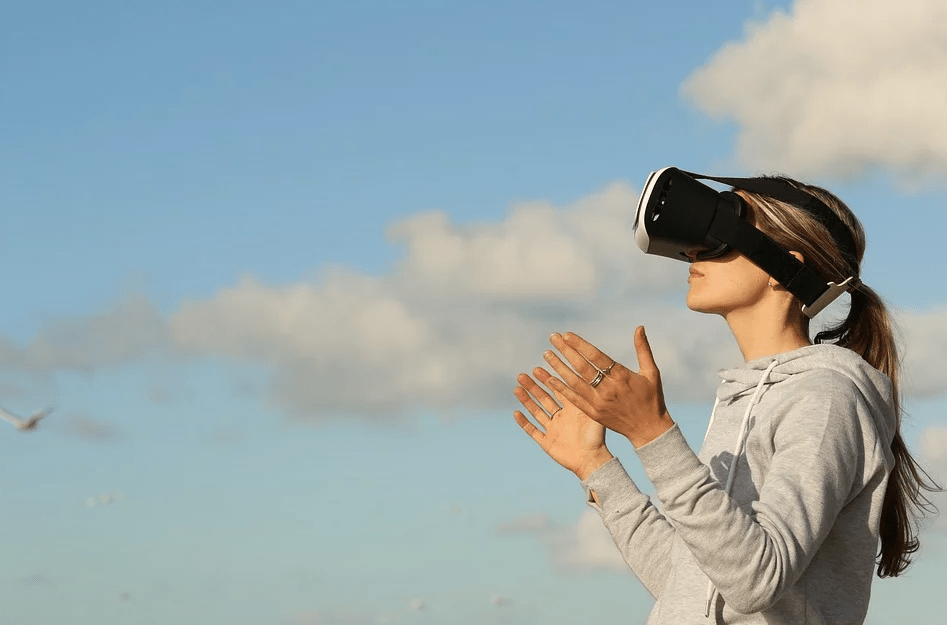
A few months ago I experienced virtual reality at a technology conference. I didn’t try a game sequence or anything that exciting, all I viewed was a scenic setting. I opened my eyes and appeared to be sitting on top of a beautiful picturesque mountain with the wind blowing. I turned my head and saw the image change, as if I were really there. All of a sudden I began to feel quite emotional, as I started to feel relaxed. I realised that I hadn’t felt relaxed in a very long time, and the virtual reality device made it happen instantly. Virtual reality shuts out the real world.
I felt a wave of emotion come over me, as if I had never experienced being calm. I wonder if I was in the exact same setting in real life on top of a mountain, looking down, would I feel the same way? Stress has a way of staying there, lurking in the background, even when you think it’s gone.
Is this the only way that we can feel less stressed in our everyday lives now? Will this be the future solution to stress?
Is technology to blame for the rise in stress levels or is it a bigger problem?
Have you experienced virtual reality before, how did it really make you feel?


 Hannah Catherine